

Important Disclaimer
This article is intended for general informational purposes only and does not constitute tax, legal, or accounting advice. Tax treatment of roofing expenses depends on specific facts, current IRS regulations, and applicable laws. Property owners should consult a qualified tax professional or CPA to determine how these rules apply to their situation.
Preparing for Next Tax Season:
Is Your Commercial Roof a Capital Expense or an Operating Expense?
As you begin planning for next year—one question becomes increasingly important for commercial property owners:
How should roofing work be classified financially?
Is it a repair (operating expense) or a capital improvement (capital expense)?
The answer matters.
It affects:
- How costs are reported
- Whether expenses are deducted immediately or depreciated over time
- How your building is valued
- How future budgets are planned
This guide explains what current U.S. tax rules say about roofing expenses—and what property owners should know as they prepare for tax season.
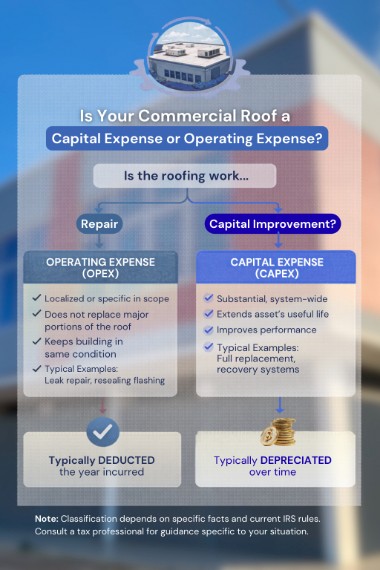
Understanding the Difference: Capital Expense vs. Operating Expenses
Operating Expense (OpEx)
An operating expense generally refers to routine maintenance or repairs that:
- Keep a property in its normal operating condition
- Do not materially add value to the building
- Do not significantly extend the building’s useful life
Examples may include:
- Minor leak repairs
- Sealing seams or flashing
- Cleaning drains
- Routine maintenance work
Under IRS rules, these types of costs are typically considered deductible in the year they are incurred, provided they meet the definition of a repair.
Capital Expense (CapEx)
A capital expense refers to work that improves, restores, or adapts a building or its systems.
According to IRS guidelines (notably the Tangible Property Regulations under Treasury Regulation §1.263(a)), an expense must be capitalized if it:
- Betters the property (improves condition or performance)
- Restores the property (returns it to a like-new condition)
- Adapts the property to a new or different use
In roofing, this often includes
- Full roof replacement
- Major roof recovery systems
- Structural or insulation upgrades
- Significant system-wide improvements
These costs are generally capitalized and depreciated over time, rather than deducted immediately.
What the IRS Specifically Says About Roofs
Commercial roofs are considered part of a building’s structure.
Under current U.S. tax law:
- A roof is classified as part of the building system
- Major work on the roof is typically evaluated under the “Betterment, Restoration, or Adaptation” tests
- If work meets one of those criteria, it must be capitalized
Additionally:
- The Tax Cuts and Jobs Act (TCJA) clarified that nonresidential roofs qualify for bonus depreciation and Section 179 expensing, subject to current limits and rules
- Roof improvements to nonresidential real property may be treated as Qualified Improvement Property (QIP) in certain cases
Because tax rules can change, it is important to verify current eligibility with a tax professional.
When Roofing Work Is Typically Considered a Repair
Roofing work is more likely to be classified as an operating expense when it:
- Addresses a specific, localized issue
- Does not replace a major portion of the roof
- Does not significantly extend the roof’s overall useful life
- Maintains the building in its existing condition
Examples:
- Repairing a small membrane tear
- Resealing flashing around a penetration
- Fixing a localized leak
These are generally considered maintenance activities, not improvements.
When Roofing Work Is Typically Considered a Capital Improvement

Roofing work is more likely to be classified as a capital expense when it:
- Replaces a substantial portion of the roof system
- Extends the useful life of the building
- Improves energy efficiency or performance significantly
- Involves structural or system-wide upgrades
Examples:
- Full tear-off and replacement
- Installing a new insulation system
- Large-scale recovery or overlay systems
- Replacing major sections of membrane across the building
These are considered improvements, not repairs.
Why This Classification Matters
The distinction between repair and capital improvement has real financial implications.
Immediate Deduction vs. Depreciation
- Repairs (OpEx): Typically deducted in the current tax year
- Capital Improvements (CapEx): Typically depreciated over time
Cash Flow Impact
Immediate deductions can reduce taxable income in the current year, while capitalized expenses spread that benefit over multiple years.
Asset Value
Capital improvements may increase the recorded value of the property, which can impact financing, resale, and long-term planning.
Important Note on Section 179 and Bonus Depreciation
Under current law:
- Certain roofing improvements to nonresidential real property may qualify for Section 179 expensing
- This allows businesses to potentially deduct the full cost in the year the improvement is placed in service, subject to limits
Additionally:
- Bonus depreciation rules may apply depending on the year and current legislation
Because these provisions are subject to legislative changes and eligibility requirements, they should always be confirmed with a CPA or tax advisor.
The Role of Documentation

Regardless of how roofing work is classified, documentation is critical.
Property owners should maintain:
- Detailed invoices
- Scope of work descriptions
- Inspection reports
- Before-and-after photos
- Contractor certifications
This documentation supports proper classification and may be required during audits or financial reviews.
How Etheridge Roofing Supports Property Owners
At Etheridge Roofing, we focus on providing the technical clarity and documentation property owners need to make informed decisions.
We help by:
- Clearly defining scope of work
- Distinguishing between repair and system-level work
- Providing detailed reporting and records
- Ensuring work meets manufacturer and code standards
While we do not provide tax advice, we regularly work alongside property owners and their advisors to ensure roofing decisions are well-documented and properly understood.
Plan Before the Year Ends
One of the most effective strategies for managing roofing costs is planning ahead of tax season—not reacting during it.
Understanding whether your roofing project is likely to be classified as a repair or a capital improvement allows you to:
- Align work with financial goals
- Coordinate with your CPA early
- Avoid last-minute decisions
- Make smarter long-term investment
Sources
- Internal Revenue Service (IRS), Tangible Property Regulations, Treasury Regulation §1.263(a)-3
- Internal Revenue Service (IRS), Publication 535 – Business Expenses
- Internal Revenue Service (IRS), Publication 946 – How to Depreciate Property
- Tax Cuts and Jobs Act (2017), Public Law 115-97
- Internal Revenue Service (IRS), Section 179 Deduction Guidelines
Popular Posts

Selecting the appropriate roofing system is...


The connection between the quality of our...
Recent Posts

When faced with Emergency Commercial Roof...

As hurricane season approaches, property managers...